
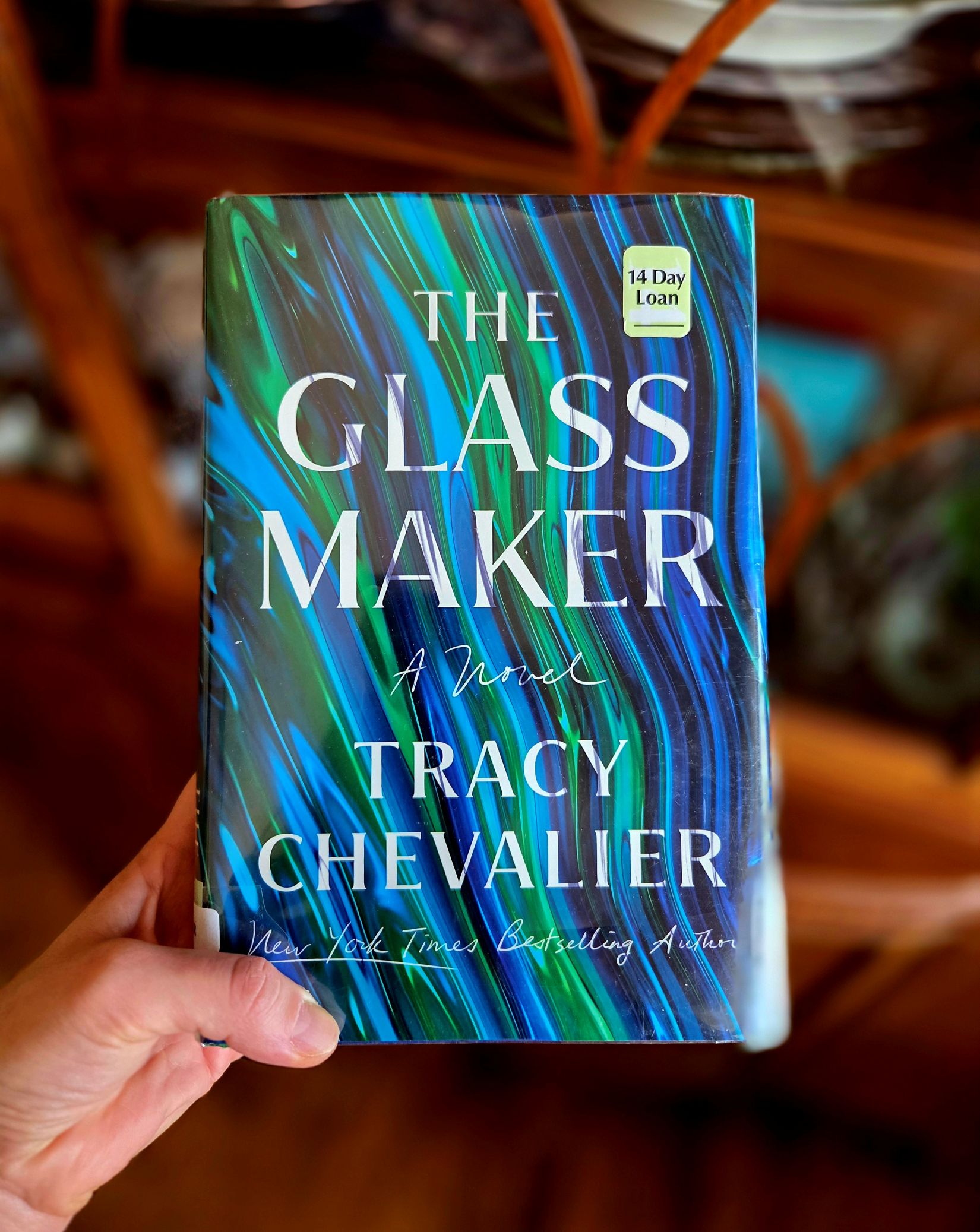
Tracy Chevalier is one of my all-time favorite novelists. I’d been eagerly waiting for her next book to come out since I read A Single Thread, and I was very excited to pick up The Glassmaker as soon as it published last year.
Tartlets, Chavelier did not disappoint. (Does she ever?? No. No, she does not.)
What’s The Glassmaker about?
Chevalier jumped on the multi-generational family saga trend with The Glassmaker. This historical fiction novel focuses on the Rossos, a family of glassblowers on the Venetian island of Murano. (Yes, as in Murano glass beads.)
We meet the Rossos in 1400s Italy, where their glass workshop is thriving. When a family death occurs that could shutter the workshop, the remaining members must pivot their livelihoods to maintain their existence on the island. Eldest daughter Orsola (I love this Italian spelling of “Ursula”!) painstakingly learns how to make glass beads, and this shapes the course of the novel.
The Glassmaker spreads the story of the Rosso family over hundreds of years, creating an unusually fantastical timeline for the novel. (It reminded me a bit of The Invisible Life of Addie La Rue.) We follow Orsola and her ever-changing family as they endure the Plague, the domination of Napoleon, World War I and II, and even COVID. There are challenges and successes, losses and gains, deaths and births, love and rivalry. The reader is there as it all unfolds over the centuries.
What I loved about The Glassmaker
Although the protagonist is Orsola, the real star of The Glassmaker is Venice. Chevalier paints an exquisite portrait of this beguiling city. The book spends the most time in Venice during the medieval and Renaissance periods, when the city was at its height for trading, elegance, and luxury.
Chevalier’s writing made me fall in love with Venice – or, with the version of Venice she created in her novel. I’ve never been inclined to visit the city, but I’m definitely intrigued now. She captures the beauty and magic of the ancient city of waterways, showing us how much has changed over the years to bring Venice to how it is now.
In contrast to the bustling, dazzling city is the nearby quiet island of Murano, where Orsola and all of the other glassmaking families live. Most of the novel takes place on Murano, with its community feel of family and friends all living and working with each other, mostly in harmony.
The Glassmaker delves into speculative fiction
Something that makes The Glassmaker truly unique is its timeline. Chevalier tries to set the reader up early for this, using a slightly confusing analogy about a skipping stone to explain how time moves differently in Murano. While just a few days pass on Murano, years pass by anywhere outside of Orsola’s city.
This “flex time” is how we’re able to experience Orsola in her 20s, during 1400s Venice with plague and Carnival masques and washing laundry by hand, and then witness her life in 2021, when she’s in her 60s and texting people on cell phones and dealing with COVID. (Don’t worry, the COVID section is very brief.)
The time skipping is odd, I’ll give you that. However, I didn’t really notice it too much until we hit the 1800s timeline. Characters start referencing a train coming through, and I was like, wait, what? Up until that point, I still thought the story was set in the 1400s.
Despite how many decades are traversed, Chevalier is able to skim over major time period changes. From about 1400 – 1800, very little changes in Orsola’s life: people still see by candlelight, people die from illnesses, women are still treated like crap, etc. It’s not until The Glassmaker pulls into the late 1800s that you start to see an astonishing amount of change in a very short time period: electricity, locomotives, penicillin, internet, women’s rights, among other things.
While it’s interesting to see Orsola “adapt” to all the changes over hundreds of years, and to see Venice thrive, fall, and rise again, I’m not sure using this timeline added anything to the book. I would still have enjoyed the Orsola’s story if it took place entirely in the 1400/1500s.
Should you read The Glassmaker?
I recommend reading The Glassmaker if you want to lose yourself in a lovely piece of historical fiction with a unique setting and even more unique timeline. I didn’t love this Chevalier novel as much as I loved A Single Thread, but I couldn’t wait to get back to Orsola’s world each time I stopped reading.
I don’t want to give anything away, but my favorite thing about The Glassmaker is that it’s not a tale of overnight success. It’s a tale of survival. It’s about eking out a life for yourself that you love, and trying and failing and trying and succeeding.
What’s the book-inspired recipe for The Glassmaker?
Stay tuned for the book-inspired recipe: Fig, Lemon Mascarpone, and Honey Cicchetti.


