
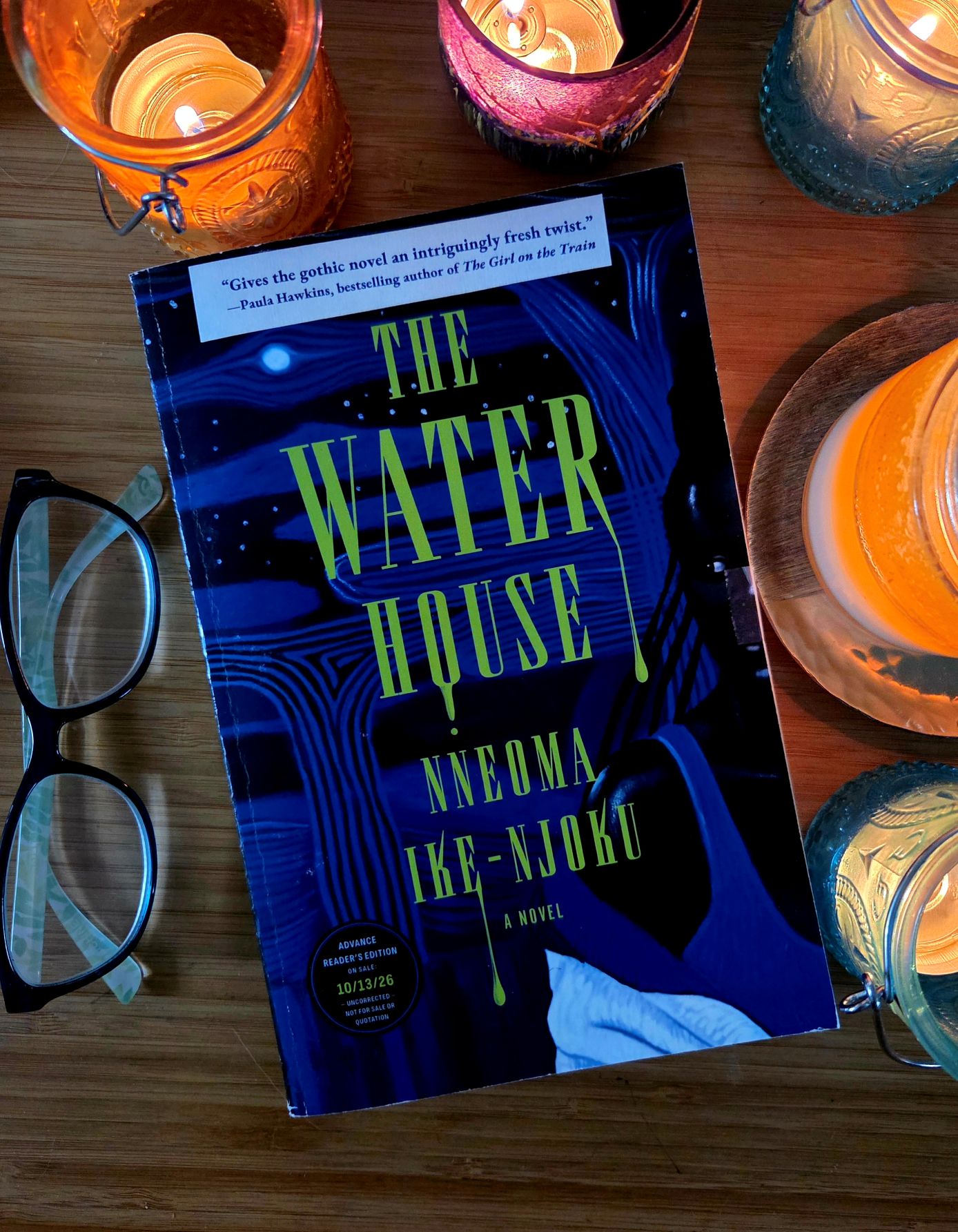
I finished reading The Water House. But, I wished I’d DNF’d it.
I kept hoping it would get better.
It didn’t.
Sigh.
What’s The Water House about?
Billed as a modern twist on Jane Eyre and Rebecca, The Water House is set in 1960s Nigeria. It follows Celia, who was sent to reform school as a young girl after she was accused of drowning her brother. After Celia graduates, she moves to “the city” for a job as a rather unskilled typist.
Somehow, Celia manages to attract the attention of an eccentric and up-and-coming politician. He asks her to marry him soon after, though as a business deal instead of for love. The engagement doesn’t last, and Celia returns home to “The Water House,” where her estranged mother still lives, to nurse her wounds and figure out her next steps.
What I liked about The Water House
Part 1 of The Water House isn’t bad. It’s mundane while still being interesting. I liked learning about Celia, about her brief personal history and then about her life in the city.
Author Nneoma Ike-Njoku draws heavily from Jane Eyre in this section. Celia’s life in reform school and the city closely mirrors Jane’s time at Lockwood and Thornfield Hall. And, when Celia becomes engaged to her own “Mr Rochester,” no one can figure out how or why this arrangement came about.
I always liked those beginning parts of Jane Eyre best. That time before she discovers Bertha Mason in the attic and runs away from Thornfield. Similarly, I enjoyed Celia’s parallel beginnings in The Water House.
What I didn’t like about The Water House
Part 2 and Part 3 of The Water House were not as entertaining as Part 1. While I get this is literary fiction, and the plot is much more character-based than action-based…there just didn’t feel like there was any movement at all.
Also, a “gothic tale” is supposed to be a little chilling, a little spooky, a little suspenseful. But nothing even remotely eerie happens at The Water House.
There’s a nice, if slightly eccentric housekeeper; there’s a male neighbor who calls on Celia more than a married man like him should; there’s Celia’s reclusive and seemingly resentful mother; and then there’s the memory of Celia’s brother, Ruben, who drowned at The Water House.
Not the ghost of Ruben, mind you. That would have been nice. Welcome, even.
Alas, no.
Ike-Njoku makes Ruben’s death a key point in the book, but I didn’t feel like there was any mystery around that event. I honestly thought Ruben just drowned by accident while Celia was supposed to be watching him or something. I mean, they live in a house that’s surrounded by water. The odds are not low that someone might accidentally drown.
Admittedly, I was a little shocked by the ending of The Water House. Not because we finally found out the truth. But because the reveal felt like it came out of nowhere. It had no impact on me other than prompting a shoulder shrug, followed by a tepid, “Meh. Are we done now?”
Should you read The Water House?
Unfortunately, I don’t recommend reading The Water House. Nothing about it truly gripped me and urged me to keep reading, other than the (disappointed) hope that the story would get better.
My dissatisfaction with this novel reminds me of how I felt reading (and then DNF’ing) Catherine House a few years ago. The book description for The Water house promised “horrors that the house holds deep in its walls” — and the book itself didn’t deliver.
Although I received a complimentary advance copy of The Water House from Summit Books, all opinions expressed in this review are my own. I was not compensated in any way for this review or for any other promotion/publicity I’ve done related to this book.


